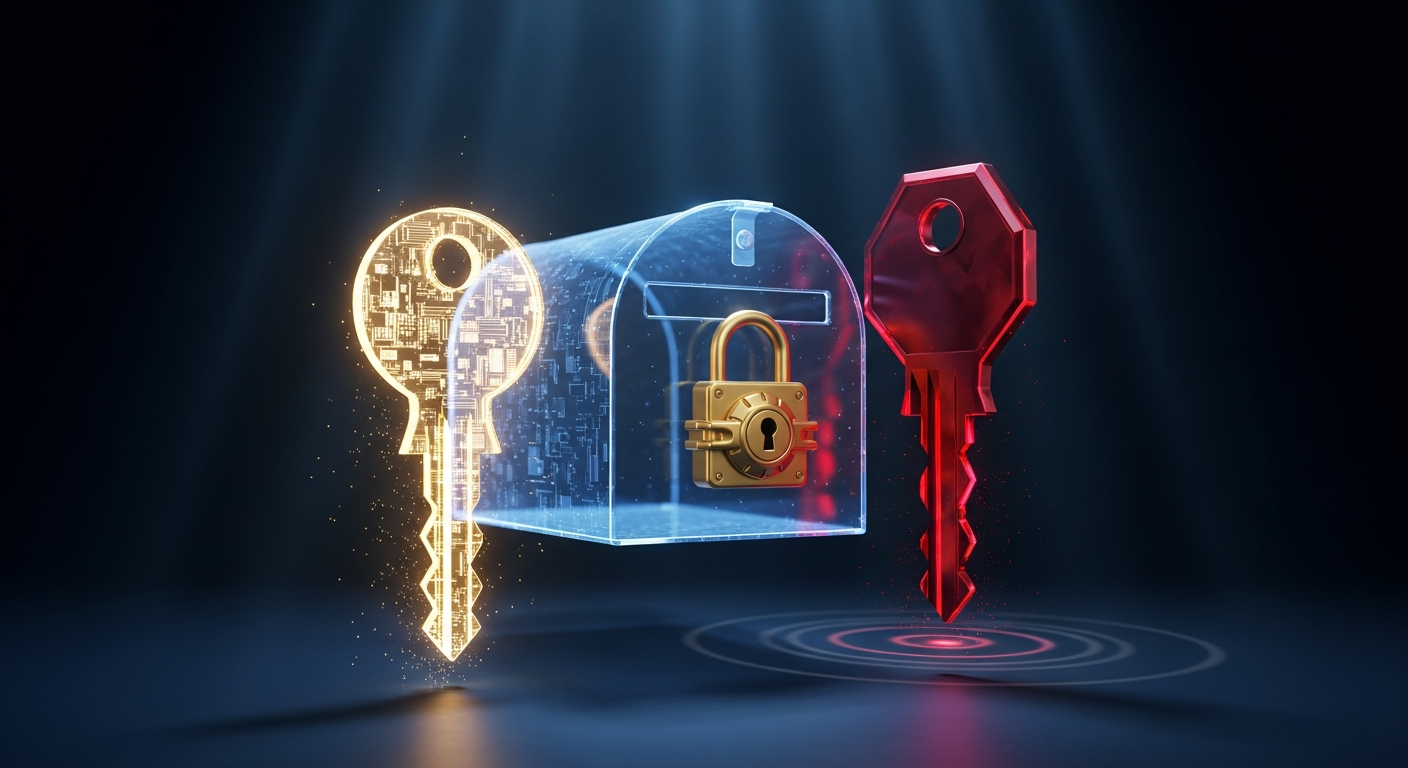

Open a crypto wallet for the first time and you get handed a few things that make no sense yet: a long string called an address, talk of a public key and a private key, and a list of words called a seed phrase. It feels like a lot at once, and that confusion is where a lot of beginners lose money. But the idea behind it is simple once the pieces click into place.
This guide walks through each part in plain language. There is no maths to follow. I will lean on a mailbox analogy to show which pieces you are meant to share and which ones have to stay secret for good. By the end you will know what each key does, how a transaction gets signed, and why handing a private key or seed phrase to anyone is the one mistake you can never take back.
Getting these basics right is the best thing a newcomer can do. Nearly every stolen-crypto story traces back to someone who never sorted out what was public from what was private.
The mailbox analogy
Picture a mailbox out on a public street. There is a slot on top where any passerby can drop a letter, and a locked door on the front that only one key opens. The slot is open to the world. The key belongs to you and nobody else.
A crypto wallet works the same way:
- Your wallet address is the slot. Anyone can use it to send you funds. Sharing it is safe and necessary, the same as giving someone your mailing address so a letter can reach you.
- Your private key is the only key to that locked door. It is the one thing that opens the box and lifts out what is inside. Whoever holds it controls the money.
The split is the whole point. You could print the slot on a billboard for the whole town to see, because seeing it does not let anyone open the box. Hand over the key, though, and the mailbox stops being yours. Hold on to that picture as we go through each piece.
What a private key really is
The private key is what your wallet is built on. Underneath, it is a very large secret number, but treat it as the master password to your funds. No company keeps a copy for you. There is no reset button if it goes missing.
A few things set the private key apart:
- It is generated at random when your wallet is first set up, so it is unique to you and all but impossible to guess.
- Everything else, your public key and your address, is derived from it mathematically. The flow goes one direction only: the private key produces the public pieces, but no one can run that math backwards from those pieces to recover your private key.
- Holding the private key means controlling the money. Nothing sits above it to overrule it.
Since so much rides on this one secret, staying safe in crypto really comes down to a single job: keeping your private key out of everyone else's hands.
Public keys and wallet addresses
The wallet takes your private key and calculates a public key from it, then calculates your wallet address from the public key. You will hardly ever touch the public key yourself. Day to day, the address is what you hand out.
Here is how the two public pieces fit together:
- The public key is a value safely derived from your private key. It works mostly behind the scenes, confirming that a transaction was approved by the matching private key.
- The wallet address is a shorter, handier form, usually a string of letters and numbers, that you give people so they can send you funds.
The thing to remember is direction. Your private key creates your public key and address, but you can never reverse those public values back into the private key. So go ahead and post your address in public, paste it into a message, or put it on a website. Anyone who sees it learns where to send money, never how to take it.
How a transaction is signed
When you send crypto, you do not hand over your private key. Your wallet uses the private key to create a digital signature, and only that signature goes out to the network. You can grasp the idea with no maths at all.
Think of signing a cheque:
- The transaction details, who is sending, who is receiving, and how much, are like the writing on the cheque.
- Your private key produces a unique signature proving you approved exactly those details. Change even one detail and the signature comes out completely different.
- The network then uses your public key to verify the signature is genuine, without ever seeing your private key.
Here is the clever bit. You prove ownership and approval without ever revealing the secret. The private key stays on your device, yet anyone can confirm the transaction is legitimate. That is also why approving a transaction carries so much weight, and why you should read carefully before you sign anything.
Seed phrase versus private key
Beginners mix up the seed phrase and the private key all the time. They are closely related but not the same, and the difference matters for protecting both.
- A private key usually controls a single account or address.
- A seed phrase is a list of 12 or 24 ordinary words that serves as the master backup for your whole wallet. From those words, your wallet can regenerate every private key and every address it holds.
The seed phrase is the master key to the whole building. A private key is the key to one apartment. Anyone holding your seed phrase can rebuild your entire wallet on any device and walk off with everything in it, often in seconds. The words exist for a practical reason: a short list of plain words is much easier to write down and store safely than a long string of random characters.
In practice, guard the seed phrase and the private key with exactly the same secrecy. Expose either one and your funds are at risk.
Why you must never share the private key or seed phrase
The reason is blunt: whoever gets your private key or seed phrase has full, permanent control of your funds. They do not need your phone, your password, or your permission. They load your secret into their own wallet and move everything out.
This is where crypto parts ways with a bank account:
- There is no chargeback and no reversal. Once a transaction is confirmed on the blockchain, it cannot be undone.
- There is no support line that can freeze a thief's account or claw back stolen funds.
- The request itself is the red flag. No legitimate wallet, exchange, website, or support agent ever needs your seed phrase or private key. A genuine app asks for the phrase once, on your own device, when you first restore an existing wallet.
So never type your seed phrase or private key into a website, chat, form, or pop-up, and never share it with anyone for any reason. The safest home for these secrets is offline, written on paper or metal, where no camera, screen, or online service can grab them.
Losing versus leaking: what happens to each
It pays to keep two very different dangers apart: losing a secret and leaking a secret. Their outcomes are opposites, and seeing both clearly shapes how you store your keys.
- If you lose your private key or seed phrase with no backup, you lose access to your funds. The money is still sitting on the blockchain, but without the key there is no way into the wallet. No company can recover it for you.
- If you leak your private key or seed phrase to someone else, that person can drain your wallet. Here the danger is theft, not lost access, and it can strike the moment they get the words.
That is why good storage has to satisfy two goals at once. You need a backup so a lost phone or a dead device cannot lock you out, but that backup has to live somewhere only you can reach. A phrase written on paper and kept securely offline guards against losing and leaking alike. A phrase typed into a cloud note or a website fails on both counts.
Addresses are public and visible to everyone
One thing that catches newcomers off guard is how open the blockchain is. Every transaction lands on a public ledger, and anyone can look up an address with a free tool called a block explorer.
For any address, a block explorer can show:
- The current balance and the tokens it holds.
- The full history of transactions in and out.
- The addresses it has interacted with.
This openness is built in on purpose, and it is not a security flaw, because seeing an address never reveals the private key behind it. What it does mean is that addresses are pseudonymous, not fully anonymous: the activity is on display even if your real name is not stuck directly to it. Most beginners have nothing to fear here, but keep in mind that anyone you share an address with can see its balance and history. Sharing your address is still perfectly safe. Only the private key and seed phrase have to stay secret.
Key Takeaways
- ✓Your wallet address is like a mailbox slot: anyone can send to it, and sharing it is completely safe.
- ✓Your private key is the only key that opens the box, and whoever holds it controls the funds.
- ✓The private key creates the public key and address, but those public pieces can never lead back to the private key.
- ✓Signing a transaction proves you approved it without ever exposing your private key.
- ✓A seed phrase is the master backup for your whole wallet, while a private key usually controls one account.
- ✓Lose a key and you lose access for good. Leak a key and a thief can drain your wallet in seconds.
- ✓Addresses are public and visible on block explorers, so never share a private key or seed phrase.
Frequently Asked Questions
Is it safe to share my wallet address?+
Yes. Your address is a mailbox slot meant for receiving funds, and sharing it cannot expose your private key. Anyone who has it can send you money or look at your public history, but they can never take anything out of your wallet.
What is the difference between a private key and a seed phrase?+
A private key usually controls one account. A seed phrase is a list of 12 or 24 words that backs up your entire wallet and can regenerate all of its keys. Both are secret, so guard them with the same care.
If someone sees my transaction on a block explorer, can they steal my funds?+
No. Block explorers only show public data such as balances and transaction history. None of that reveals your private key, so your funds stay safe as long as the key and seed phrase remain secret.
What happens if I lose my seed phrase?+
If you lose it with no backup, you lose access to your funds for good. The money is still on the blockchain, but without the seed phrase or private key there is no way into the wallet, and no company can recover it for you.
Why does signing a transaction not reveal my private key?+
Signing uses the private key to create a unique signature for that one transaction. The network verifies the signature with your public key, confirming you approved it, while the private key itself is never seen or transmitted.
Sources & Further Reading
This guide is general educational information, not financial, legal, or security advice. Crypto transactions are irreversible, always do your own research and verify independently before acting.