
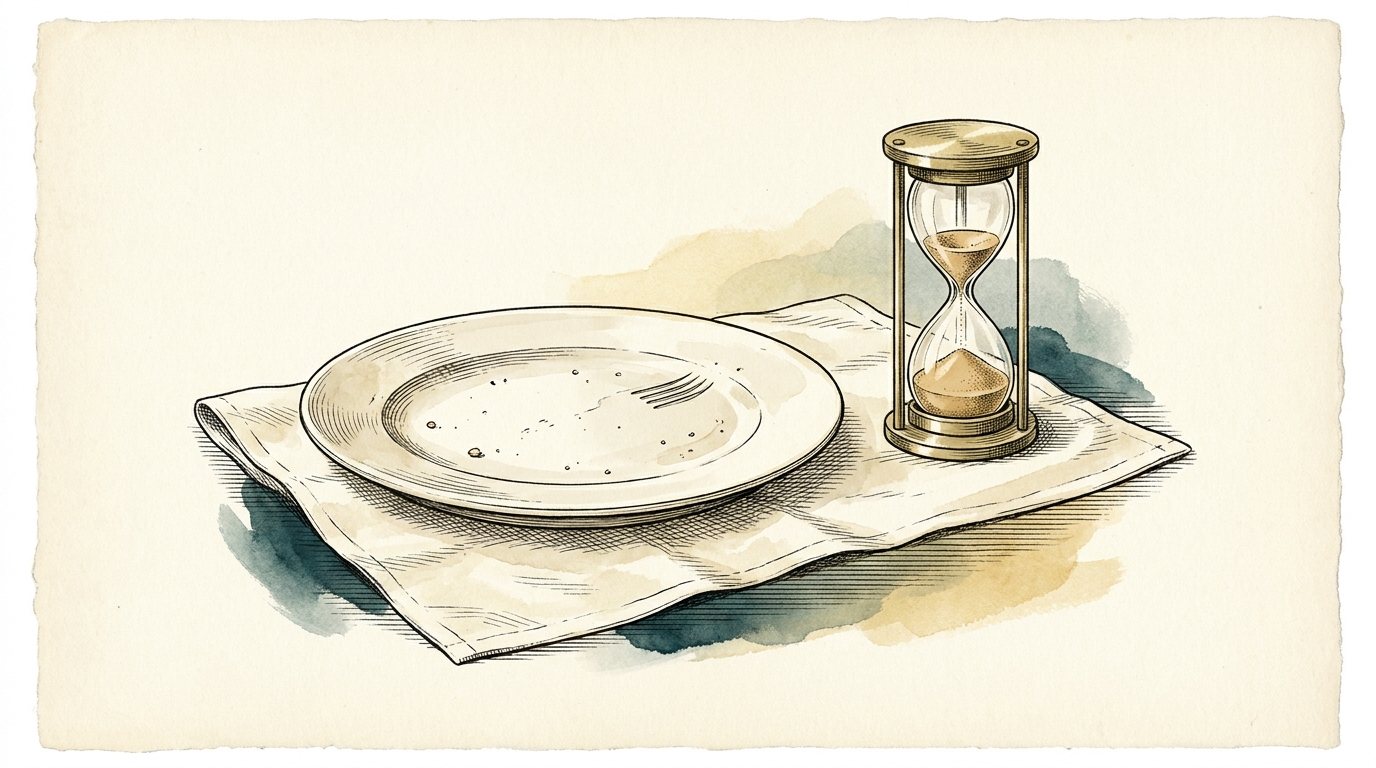
The oldest result in the biology of ageing is also one of the simplest. In the 1930s, laboratory rats kept on a diet with substantially fewer calories lived longer than rats allowed to eat freely. The finding has since been repeated across species, in mice and rats, in yeast and in flies. Few interventions in this field survive that much repetition. Almost none survive it with this much consistency.
What the animal work actually shows
In rodents, restricting calories without causing malnutrition extends median lifespan in most studies, and usually extends maximum lifespan as well. The effect is graded: within limits, the more restriction, the larger the gain. Unlike many ageing interventions, it works even when started in adulthood, which matters because it means the biology is not fixed at birth. The animals also look healthier by the usual measures of frailty, with later onset of tumours and metabolic disease.
The first honest caveat appears here. The size of the effect depends on the strain, the diet and the feeding schedule, and it is not universal. Some genetic backgrounds show little benefit. And the comparison group matters: a laboratory animal eating freely is often heavier than an ideal weight, so part of what restriction looks like is simply the absence of overfeeding.
The monkeys disagreed with each other
For decades the obvious question was whether primates would show the same result, and two long studies were set up to answer it. They ended with opposed headlines. One, at the University of Wisconsin, reported improved survival in restricted rhesus monkeys. The other, at the National Institute on Aging, found health improvements but no significant gain in lifespan. When the feeding protocols and diets were compared, a large part of the gap came down to method: what the control animals were eating, how often meals were served, and what counted as a normal diet. The lesson was not that one study lied. It was that caloric restriction is not one intervention, and the control group is half of every experiment.
The two year human trial
In people, the largest randomized attempt to date is a two year study known as CALERIE. Participants were assigned either to eat as usual or to aim for roughly a quarter fewer calories. The target was not fully reached; on average the restricted group sustained something closer to a tenth less. What came out of the trial was a set of measurable changes: weight loss, lower blood pressure, improved cholesterol and inflammatory markers, and better insulin sensitivity. For a metabolic intervention sustained over two years, that is a solid result.
What the trial could not show is the thing everyone wants to know. Two years is a short interval in a human life, and the study was designed to measure risk factors, not survival. Improvements in markers are not proof of longer life, however reasonable the expectation. Some safety signals also drew attention, including loss of bone density at certain sites, and the practical difficulty of eating substantially less is real: adherence is the quiet moderator of every finding in this literature.
The evidence beyond the trial
Outside the laboratory, there are people who have restricted their eating for decades, and their metabolic profiles tend to look like the restricted arm of the trial. That similarity is interesting and it is also a caution: people who sustain such a regimen for twenty years differ from everyone else in ways no study can fully separate, from income to temperament to the simple fact that they were able to do it. Observational data cannot answer the question the trial could not. It can only raise the prior that the biology does not stop at the end of a funded protocol.
What can be said fairly
Caloric restriction is a reproducible lever on the pace of ageing in short lived animals, and a tolerable metabolic intervention with measurable effects in people for as long as it is sustained. Whether sustained restriction extends human life, and by how much, remains unmeasured, and the experiment that could answer it would take decades and raise ethical problems of its own.
That is why interest has increasingly moved to compounds that act on some of the same pathways without requiring hunger. Those are different stories with their own evidence, and they deserve their own pieces.
Continue reading
The wire that will not grow back
The optic nerve is part of the brain, and adult mammals do not repair it. That single fact is the starting point for every serious attempt to restore sight after nerve damage.
Read the piece →The results that did not survive the second look
Large replication projects have rerun hundreds of published findings. The pattern they found is one of the most important results in science about science itself.
Read the piece →The retina is nervous tissue, and that changes everything
The eye is often described as a camera. The comparison is useful for optics and misleading for almost everything else.
Read the piece →