
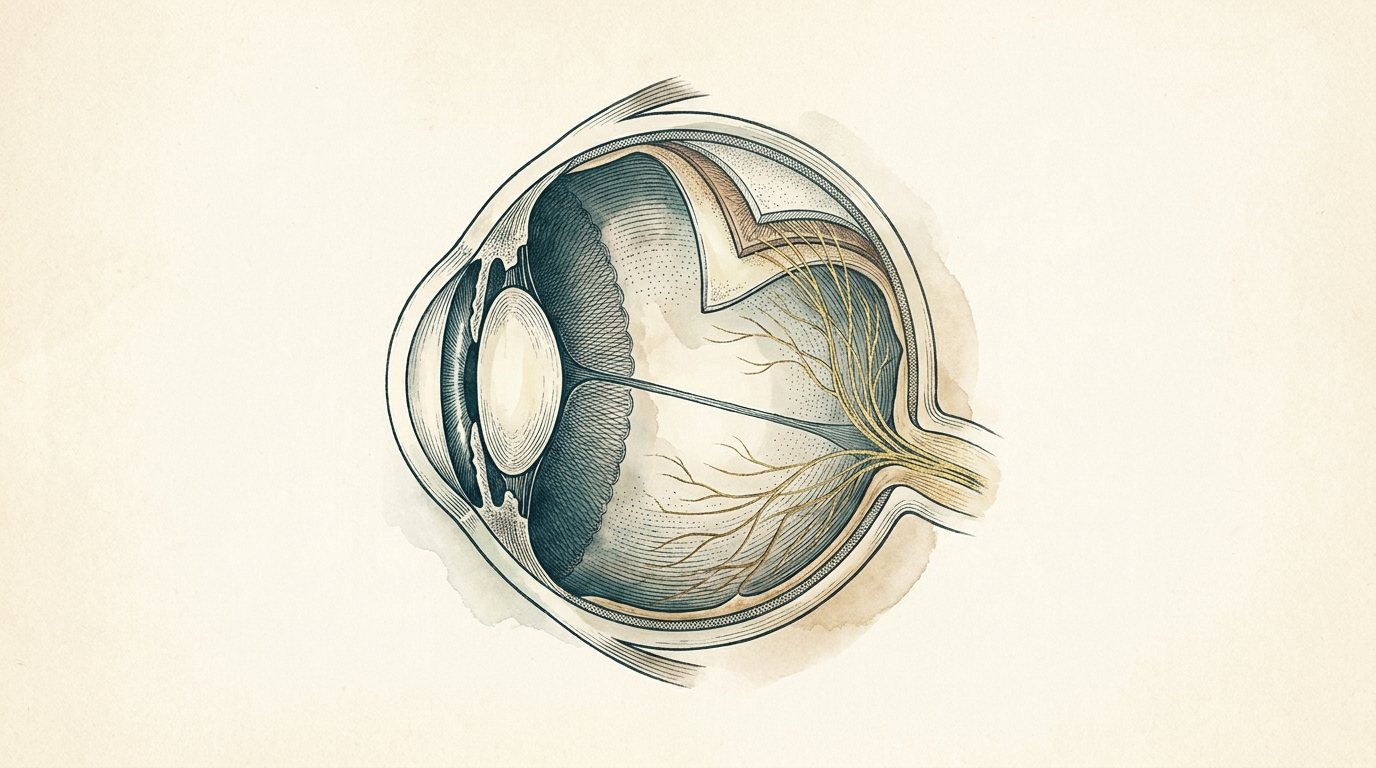
Light entering the eye is focused by the cornea and the lens onto the retina at the back of the eyeball. So far the camera comparison holds. It stops holding at the retina, because the retina is not film. It is brain tissue that happens to sit in the eye.
Layers doing work
The retina is layered. Photoreceptors, the rods and cones, sit at the back and convert photons into electrical signals. In front of them sit several classes of interneuron, and in front of those sit the ganglion cells whose long fibres bundle together to form the optic nerve. Signal passes forward through those layers, and it is heavily processed on the way.
By the time information leaves the eye it has already been edited. Contrast has been sharpened. Motion has been picked out. A great deal of raw detail has been discarded because it was redundant. The optic nerve does not carry a picture. It carries a summary, and the brain reconstructs from that summary.
Why repair is difficult
This architecture explains why restoring sight is so much harder than restoring, for example, a heart valve. Damage in the eye can occur at many different points, and each point fails differently. Loss of photoreceptors is not the same problem as loss of ganglion cells, which is not the same problem as clouding of the lens.
Clouding of the lens is largely an optical problem, and optical problems can be solved with optical solutions. That is why lens replacement became routine while retinal repair did not. The retina is neural tissue, and mature neural tissue in mammals does not regenerate readily. A photoreceptor that dies is not replaced.
Several approaches, one difficulty
Research directions include supplying a working copy of a gene where a single faulty gene is responsible, transplanting cells to replace lost ones, and bypassing the damaged layer entirely with an electronic implant that stimulates surviving cells directly.
Each faces the same underlying difficulty, which is not really biological. It is informational. The retina does not merely detect light, it encodes light in a particular language, tuned over development, specific to the individual. Restoring detection is one problem. Restoring the encoding well enough that the brain can read it is a much harder one, and it is the reason progress reads as slow from outside.
Continue reading
The cells that stop dividing but refuse to leave
Senescence is one of the most studied ideas in the biology of ageing. Here is what the term actually means, and where the honest edges of the science are.
Read the piece →The clock that starts when an organ leaves the body
Transplantation is often told as a story about surgery. Much of the real constraint is a story about time and temperature.
Read the piece →Who pays for discovery, and what that money quietly decides
Funding structure is not a footnote to scientific progress. It is one of the main forces determining which questions get asked.
Read the piece →