
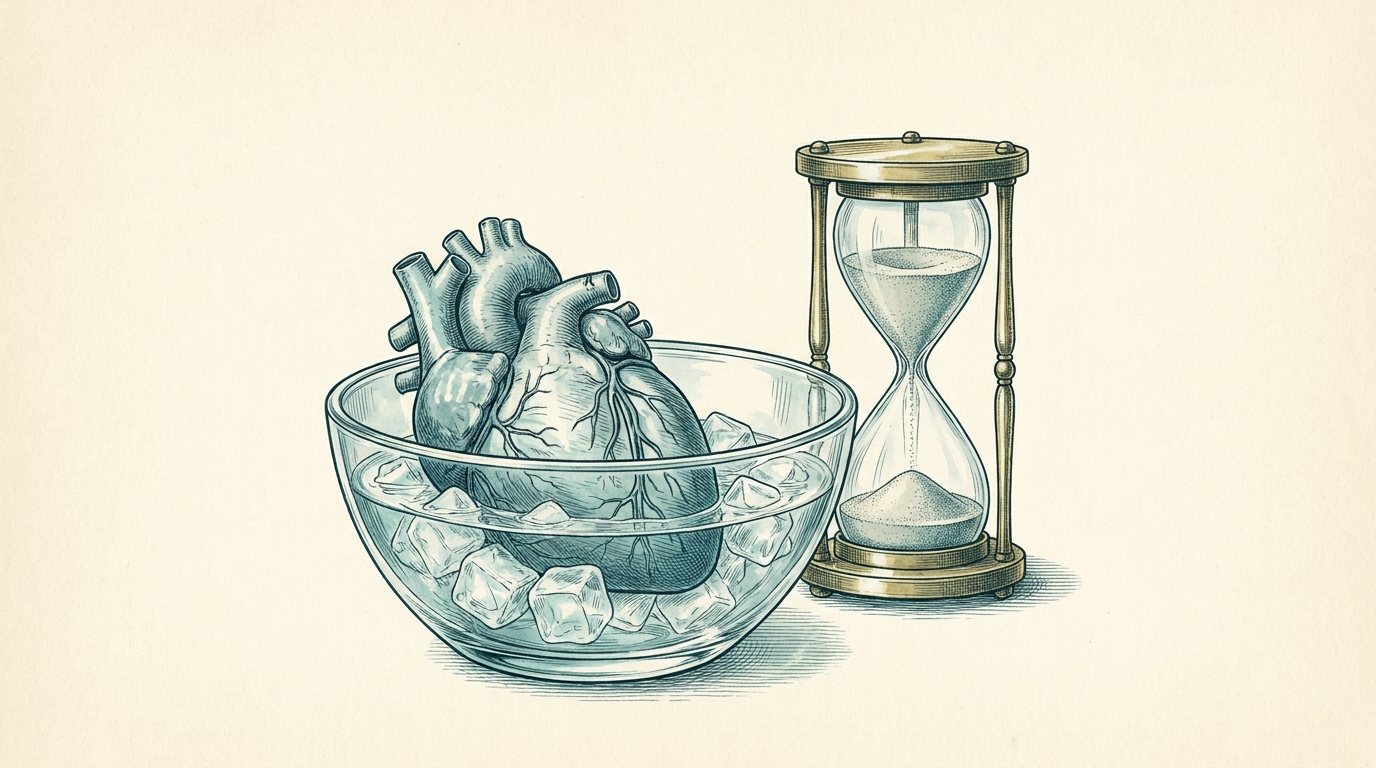
An organ removed from a donor begins to deteriorate immediately. Blood flow stops, oxygen delivery stops, and the tissue starts consuming whatever it has left. Everything that happens next is an effort to slow that process down enough to reach the recipient.
Cooling buys time and costs something
The standard approach is cold. Lowering temperature slows metabolic rate, so the tissue consumes its reserves more slowly. This is why organs travel on ice. It is effective and it is simple, and it is also a compromise, because cold is not free.
Cold slows the damaging processes but it does not stop them, and it introduces problems of its own. Cell membranes behave differently at low temperature. Ion pumps that normally maintain the balance between the inside and the outside of a cell slow down, so that balance drifts. Preservation solutions are formulated specifically to counter that drift.
Reperfusion
A second difficulty arrives at the moment the organ is reconnected. Restoring blood flow to tissue that has been deprived of it causes its own injury, distinct from the injury of the deprivation. Oxygen returning to cells that have been running without it produces reactive molecules faster than the cell can neutralise them.
This is why the window is measured in hours and why the number differs by organ. Kidneys tolerate the process comparatively well. Hearts and lungs tolerate it poorly. The difference is largely metabolic demand, which is to say how quickly the tissue burns through what it has.
Machines instead of ice
One active area of work replaces static cold storage with perfusion, keeping fluid moving through the organ during transport. The appeal is not only extended time. A perfused organ can be observed. It can be assessed while it travels rather than only on arrival.
That last point matters more than it first appears. A great many donated organs are declined because there is no way to be confident they will function. A method that allows assessment rather than prediction changes not just how long an organ lasts but how many are used at all.
Continue reading
The cells that stop dividing but refuse to leave
Senescence is one of the most studied ideas in the biology of ageing. Here is what the term actually means, and where the honest edges of the science are.
Read the piece →The retina is nervous tissue, and that changes everything
The eye is often described as a camera. The comparison is useful for optics and misleading for almost everything else.
Read the piece →Who pays for discovery, and what that money quietly decides
Funding structure is not a footnote to scientific progress. It is one of the main forces determining which questions get asked.
Read the piece →