
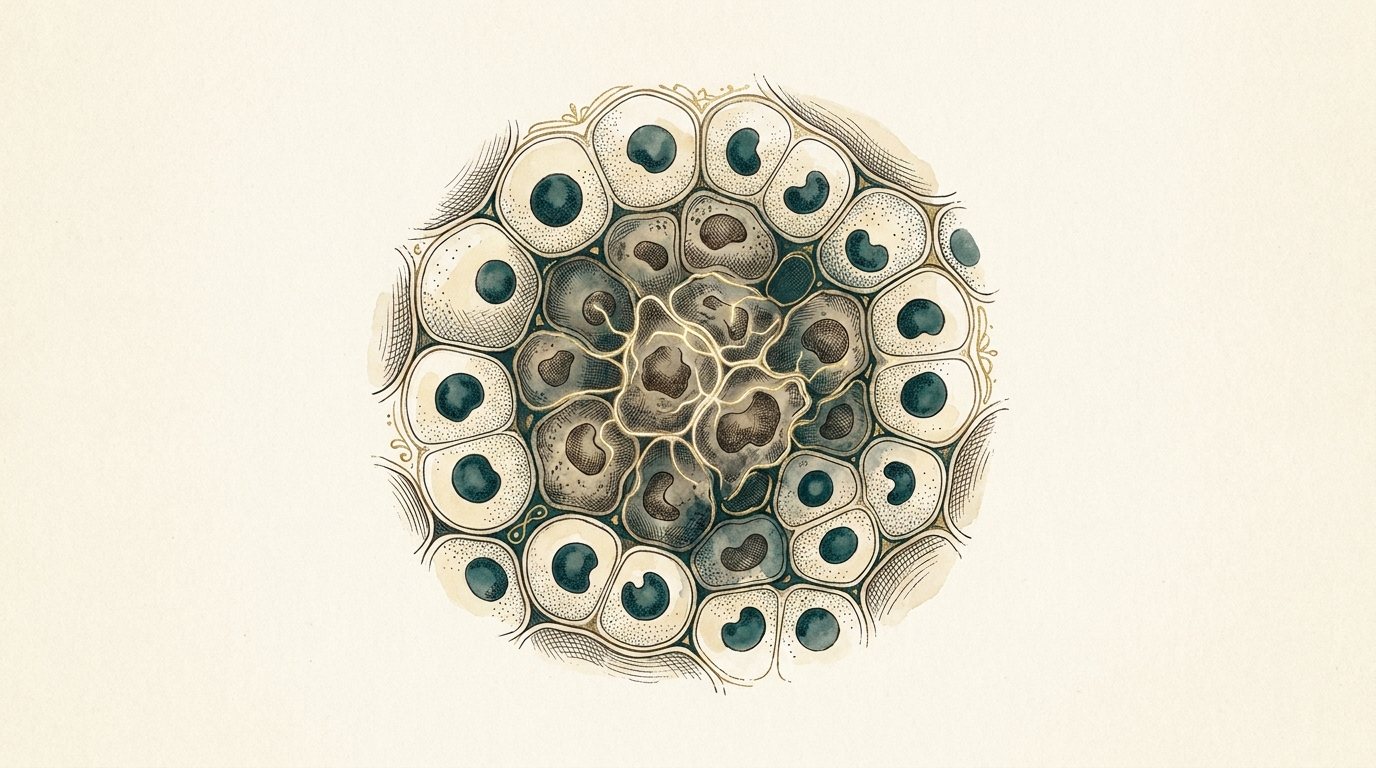
A cell that becomes senescent has permanently stopped dividing. It is not dead. It continues to consume energy, and it continues to release signalling molecules into the tissue around it. Biologists call that output the senescence associated secretory phenotype, and it is the reason these cells attract so much attention.
Why a cell would stop
Senescence is not a malfunction in itself. It is a protective response. When a cell accumulates enough DNA damage that dividing would be dangerous, halting division is the safer outcome. The alternative, a damaged cell that keeps copying itself, is closer to the beginning of a tumour. In that sense senescence looks like a brake, and for most of a lifetime it works.
The difficulty is arithmetic. Young tissue clears senescent cells efficiently. The immune system recognises them and removes them. As an organism ages, clearance slows while creation continues, so the population grows. A brake that is applied briefly is useful. A brake that is never released changes the character of the tissue.
What the secretions do
The molecules released by senescent cells include inflammatory signals. In small quantities and for short periods these signals help with wound repair and recruit immune cells to a site that needs attention. Sustained over years, the same signals contribute to a low grade inflammatory state that researchers often describe as one of the background conditions of older tissue.
This is where reporting has to slow down. It is well established that senescent cells accumulate with age in many tissues. It is well established that they secrete inflammatory factors. The step that is much harder, and much less settled, is how much of the experience of ageing is caused by that accumulation rather than merely accompanied by it.
The honest edge
Work in laboratory animals has shown that removing senescent cells can improve certain measures of function. That is a real and repeatable result and it is why the field is taken seriously. It is also a long way from a general claim about people. Animal models are chosen because they are tractable, not because they are small humans. The translation problem is the central problem of the whole field, and anyone who skips over it is selling something.
What can be said fairly is this. Senescence gave biology a specific, measurable, physical thing to point at when it talks about ageing. Before that, ageing was largely described. Now part of it can be counted. That shift, from description to measurement, is usually the point at which a field starts to move.
Continue reading
The retina is nervous tissue, and that changes everything
The eye is often described as a camera. The comparison is useful for optics and misleading for almost everything else.
Read the piece →The clock that starts when an organ leaves the body
Transplantation is often told as a story about surgery. Much of the real constraint is a story about time and temperature.
Read the piece →Who pays for discovery, and what that money quietly decides
Funding structure is not a footnote to scientific progress. It is one of the main forces determining which questions get asked.
Read the piece →