
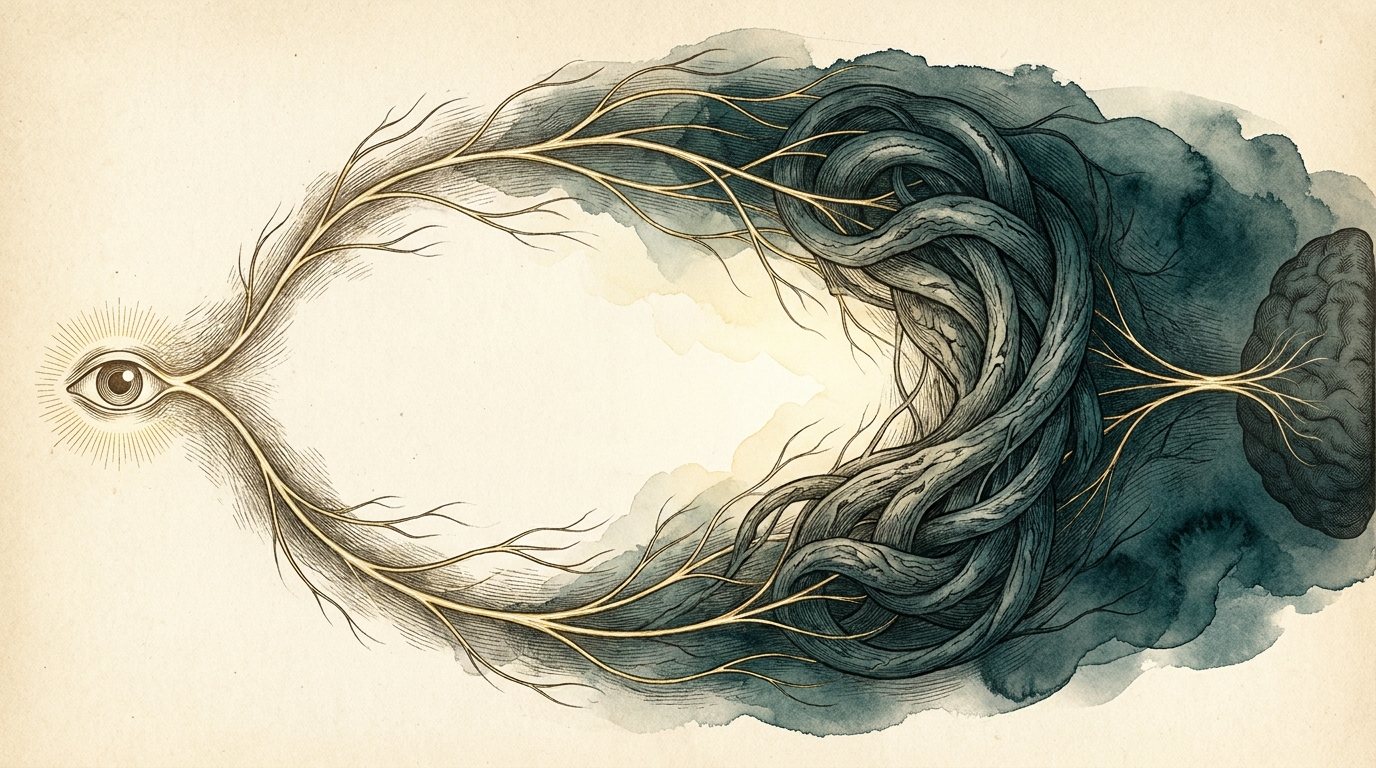
A nerve is usually described as a cable, and the analogy is close enough for most purposes. Cut a peripheral nerve in a hand and it will often regenerate. The optic nerve behaves differently, and the difference is not in the diameter of the cable but in what it is made of. It is a tract of the central nervous system, about a million fibres that grow out of the retina and travel to the brain, and central nervous system tissue in adult mammals does not repair itself.
Why the fibres stop
Each fibre in the optic nerve is the long extension of a single retinal cell called a retinal ganglion cell. During development these extensions grow toward their targets without hesitation. After birth, the machinery changes. Adult central neurons dial down their intrinsic growth programs, and the tissue around them becomes actively unfriendly to regrowth. Injured myelin releases proteins that repulse growing tips, and the scar that forms at the site of injury builds a barrier of its own. Regenerating a central axon therefore means overcoming two separate obstacles at once: a neuron that no longer wants to grow, and a neighbourhood that tells it to stop.
The mouse experiments that changed the tone
Until fairly recently, permanent damage to the optic nerve was treated as settled science. Work in mice has made that word less comfortable. By deleting genes that act as brakes on growth, such as PTEN, and combining that with growth factors or a second deletion, researchers have achieved regeneration that runs the length of the injured nerve rather than the customary few millimetres. In some experiments the regenerated fibres reached the brain and changed simple visual reflexes. Other approaches, from elevating a messenger molecule called cAMP to pulling zinc out of the tissue with a chelating drug, have produced regrowth by different routes, which suggests several independent levers exist.
This is where reporting has to slow down. The results are real and repeatable. They are also in mice, mostly young mice, using genetic changes that cannot simply be applied to a human patient. The recovery of function observed was partial at best. A reflex test looking different is not the same as a person reading a page.
Why the eye is both hard and convenient
There is a practical asymmetry that keeps this field alive. The eye is one of the few places where gene therapy can be delivered with a local injection and a local effect, and the first approved gene therapy that targets vision works exactly that way. It is worth being precise about what that treatment does: it corrects a metabolic defect inside retinal cells caused by a specific mutation. It does not regrow a nerve, and it does not apply to the injury problem described here. Conflating the two is one of the more common errors in coverage of eye therapies.
Against the promise stands a market that has moved much faster than the science. Clinics in several countries sell injections of cells into the eye for conditions including optic nerve damage, outside any approved trial. Ophthalmology societies and regulators have issued repeated warnings about these procedures, and reported harms include loss of vision. The pattern is familiar from other fields: when a condition has no treatment, unproven treatments find patients first.
What restored sight would actually require
It helps to be specific about the sequence the biology demands. The retinal cells have to survive the injury, which is not guaranteed and is a race against time. Their fibres have to cross the injury site and keep growing along the correct route. Then they have to reconnect, not merely to the brain but to the right targets in the right layers, because a visual signal delivered to the wrong place is noise. Finally the brain has to interpret the restored input. Mouse experiments have shown meaningful progress on the middle two steps; the survival step and the correct wiring step remain the least solved, and they are the parts that no headline can shortcut.
The honest edge
The gap between a mouse axon crossing an injury site and a human optic nerve restored to useful sight is the entire problem, and nobody has closed it. What has changed in twenty years is the direction of the research: from explaining why regeneration is impossible to cataloguing ways to produce it in animals. Whether those ways can be made safe and effective in people is an open experimental question, and the honest answer today is that no approved treatment regenerates the human optic nerve.
Continue reading
The trial where people ate less for two years
Caloric restriction is the most reliable way to extend lifespan in laboratory animals. The human experiment ran for two years and measured something else.
Read the piece →The results that did not survive the second look
Large replication projects have rerun hundreds of published findings. The pattern they found is one of the most important results in science about science itself.
Read the piece →The cells that stop dividing but refuse to leave
Senescence is one of the most studied ideas in the biology of ageing. Here is what the term actually means, and where the honest edges of the science are.
Read the piece →