
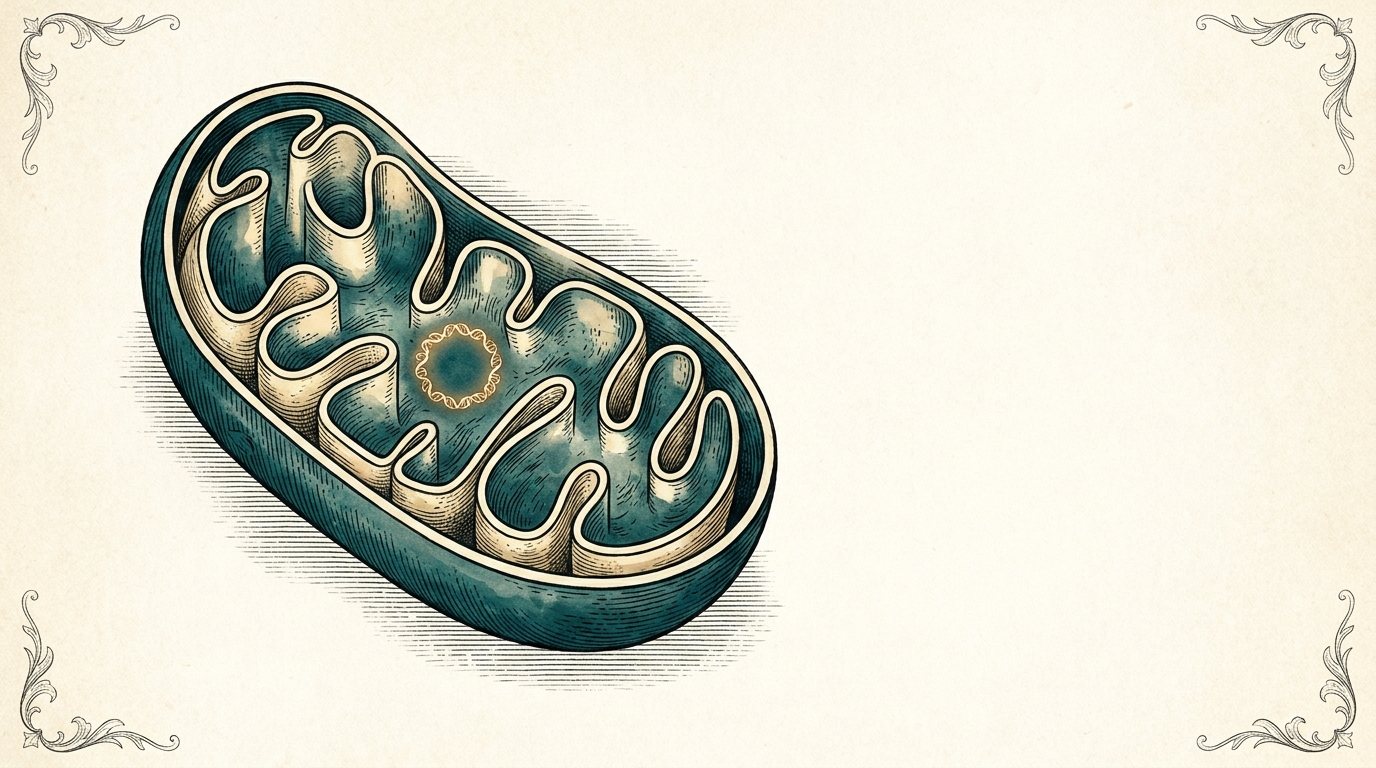
Almost every instruction for building a human being sits in the nucleus of the cell. Almost. A small, separate set of instructions sits inside the mitochondria, the compartments where most cellular energy is produced. That separation is not a quirk of filing. It is a fossil.
An ancient arrangement
The prevailing account is that mitochondria descend from free living bacteria that were taken up by another cell and never left. The relationship became permanent, and over an immense span of time most of the original genome migrated into the host nucleus. A small remainder stayed behind, and it is still there.
The supporting evidence is structural. Mitochondria have two membranes, which is what would be expected from one cell engulfing another. They divide on their own schedule rather than in step with the cell around them. Their genome is circular, which is a bacterial arrangement rather than a typical arrangement for our own chromosomes.
Why the remnant matters
Because these instructions are separate, they are inherited separately. Mitochondrial DNA passes down the maternal line. It also sits in the most chemically demanding location in the cell, immediately beside the reactions that generate energy, which are also reactions that generate reactive by products.
A cell contains many mitochondria and each contains several copies of that small genome, so damage to any one copy is diluted. The clinical picture only changes when the proportion of damaged copies crosses a threshold, and that threshold differs by tissue according to how much energy the tissue demands. Muscle, heart and the nervous system tend to show effects first.
A caution about the shorthand
Because mitochondria produce energy, and because energy is a word people apply loosely to how they feel, mitochondrial biology attracts a great deal of confident language that the science does not support. The gap between a measurable change in a laboratory preparation and a claim about how a person feels is enormous, and it is routinely stepped over.
The genuinely remarkable thing needs no exaggeration. Every person carries, in every cell, the working remains of an organism that entered into an arrangement with ours before animals existed, and that arrangement is still running.
Continue reading
The cells that stop dividing but refuse to leave
Senescence is one of the most studied ideas in the biology of ageing. Here is what the term actually means, and where the honest edges of the science are.
Read the piece →The retina is nervous tissue, and that changes everything
The eye is often described as a camera. The comparison is useful for optics and misleading for almost everything else.
Read the piece →The clock that starts when an organ leaves the body
Transplantation is often told as a story about surgery. Much of the real constraint is a story about time and temperature.
Read the piece →